
Gili T marine emergency is something most people don’t think about when they first step onto the island. Honestly, you arrive, you see blue water, you think everything is soft and slow. But then—yeah—Gili T marine emergency can shift the whole atmosphere in a way you don’t really expect until you’re there, watching it happen, or hearing about it from someone who just saw it.
It’s weird, because the island still looks calm. Same coconut trees, same bicycles, same tourists laughing too loud. But somewhere behind that, Gili T marine emergency situations are handled in a way that feels almost invisible. Not flashy. Not dramatic. Just… moving.
And maybe that’s what surprised me most.
The Quiet System Behind the Island
Nobody really explains it when you arrive. There’s no big sign saying how things work. You just slowly notice.
Emergency service Gili exists in fragments. A boat here. A radio there. Someone who suddenly knows who to call without checking notes.
And when Gili T marine emergency happens, those fragments kind of snap together. Not perfectly. But enough.
Sometimes it feels improvised. Like people are just… reacting.
But they’ve done it before. Many times.
Small Signals You Don’t Notice at First
A boat engine starts earlier than usual.
Someone stops talking mid-sentence.
A phone is passed without explanation.
That’s it. That’s often how Gili T marine emergency begins from the outside perspective. No announcement. Just movement.
And you only realize later, oh… something happened.

Medical Side That Stays Half-hidden
There’s the Gili medical service, which most tourists only know as “that clinic near the harbor.” But inside that small space, things can get serious quickly.
Cuts, diving issues, dehydration, panic cases… all sorts.
And when Gili T marine emergency overlaps with medical response, things get slightly tense but controlled. Not chaotic. Just… focused.
I once heard someone say, “It’s never quiet, but it’s never loud either.” That stuck with me.
Gili Medical Clinic Reality
The Gili medical clinic isn’t big. Not like city hospitals. But it doesn’t try to be.
It just handles what comes in.
And when Gili T marine emergency situations escalate, patients are stabilized first. Then decisions happen. Fast ones.
No long meetings. No waiting for perfect conditions.
Just action.
Boats, Water, and Timing
This part is kind of intense if you think about it too much.
Because everything depends on water transport.
If the sea is calm, fine. If not… everyone adjusts.
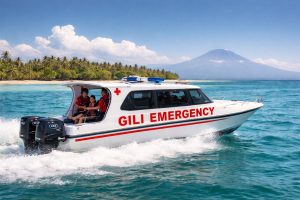
During Gili T marine emergency, boats become more than transport. They become lifelines. And that sounds dramatic, but it’s actually just practical reality.
People don’t talk much during those moments.
They just move.
The Feeling From the Shore
You’re standing there, maybe holding a drink, maybe barefoot.
Then you see speed.
Not panic speed. Controlled speed.
And you think, “Oh. This is one of those moments.”
That’s usually how you first recognize Gili T marine emergency without anyone telling you.
Communication That Feels Half-organized
There’s no perfect system. Let’s just say that.
Radios crackle. Phones get passed around. Someone walks fast instead of talking.
And still, somehow, it works.
Maybe not cleanly, but it works.
In Gili T marine emergency, information travels like water through sand—sometimes fast, sometimes slow, sometimes disappearing and reappearing somewhere else.
Rumors vs Reality
This part is funny in a strange way.
One person says something serious.
Another repeats it slightly wrong.
Within minutes, the story grows.
But the actual Gili T marine emergency situation? Often smaller than the rumor.
Or sometimes bigger, but quieter.
Hard to tell in real time.
Tourists Usually Don’t Understand It at First
And why would they?
You come for diving, sunsets, maybe party nights.
Not for thinking about emergency systems.
So when Gili T marine emergency happens nearby, tourists usually freeze for a second.
Then go back to what they were doing.
Not because they don’t care.
More like… they don’t know the scale yet.
The Strange Normality of It All
This is what gets me.
After a few minutes, life continues.
Music comes back.
People laugh again.
But somewhere, Gili Trawangan marine emergency response is still wrapping up quietly in the background.
It’s almost like two layers of reality happening at once.
Emotional Undercurrent Nobody Talks About
There’s a feeling you can’t really describe properly.
Not fear.
Not excitement either.
More like awareness sitting quietly in your chest.
You notice it especially when Gili T marine emergency is unfolding and you’re just… watching from a distance.
Not involved.
But not detached either.
A Small Human Moment
I saw a local once just nod slightly before walking fast toward the dock.
No explanation.
No drama.
That moment said more than any announcement.
That’s the kind of behavior that repeats during Gili T emergency situations.
Why Systems Like This Still Work
It doesn’t look like a perfect system.
But it’s adapted to reality.
Small island. Limited resources. High unpredictability.
So everything becomes flexible.
Emergency service Gili, Gili medical service, Gili medical clinic—they’re not separate worlds. They overlap constantly.
And in Gili T marine emergency, that overlap is what keeps things moving.
Not structure.
Flow.
After Everything Settles
And then… it ends.
Like nothing happened.
Sea becomes quiet again.
People go back to eating, swimming, biking.
That’s the part that feels almost unreal.
Because Gili T emergency can feel huge in the moment, but small in memory.
Or maybe it just fades quickly because the island refuses to stay dramatic.
One Last Thought
Maybe that’s the lesson here.
Things don’t always announce their importance loudly.
Sometimes they just pass through the system quietly, get handled, and disappear back into normal life.
And you only understand it later.
Much later.
When you’re already somewhere else, thinking about how quickly everything can shift on a small island like this.
