
There’s something oddly humbling about watching an island ambulance move at dawn. The sea still half asleep, the sky kind of pale, and somewhere in that quiet moment, Gili Air ambulance to Lombok becomes more than just a phrase—it feels like a lifeline. I remember thinking how fragile everything looks out here, and yet how organized it somehow still is. Gili Air ambulance to Lombok isn’t just a transfer service, it’s urgency wrapped in salt air and engine noise. And maybe it sounds dramatic, but when you’re actually there, Gili Air ambulance to Lombok feels like the only bridge between calm and chaos.
People talk about paradise here. And it is. Until it isn’t.
The Quiet Reality Behind Island Medical Transfers
On Gili Air, life moves slow. No cars. Just feet, bicycles, and horse carts. But emergencies don’t care about aesthetics.
When someone needs urgent care, the system shifts. You’ll hear about ambulance Gili Air services almost like whispers at first. Then suddenly it becomes very real. A stretcher. A boat. A rushed decision.
The phrase Gili Air ambulance to Lombok gets repeated a lot among locals and clinic staff, almost like a code. Simple words. Heavy meaning. It’s not just transport, it’s survival logistics.
Sometimes it’s dehydration gone too far. Sometimes diving accidents. Sometimes things nobody really talks about in detail.
And jujur saja, the silence after the boat leaves is strange. Too quiet.
How the Transfer Actually Feels
There’s no glamour in it. No cinematic music.
Just movement.
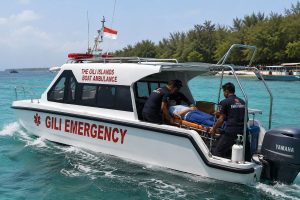
A patient is carefully moved from a small clinic, often part of Gili medical service facilities, toward a waiting boat. The ocean is right there. Always right there.
The Gili Air ambulance to Lombok process usually begins with urgency but ends in a kind of controlled calm. People settle into roles quickly. Someone holds equipment. Someone checks timing. Someone just stands and watches.
And then it goes.
Boats, Timing, and the Space Between Islands
You don’t really understand distance here until it becomes medical.
Lombok looks close. Too close to feel like “another place.” But the water changes everything. Waves, weather, timing.
There are moments when Gili emergency service teams hesitate. Not because they don’t know what to do, but because sea conditions matter more than people expect.
And still, the system moves.
The phrase Gili Air ambulance to Lombok comes up again when coordination starts between boat crews and clinic staff. It’s almost rhythmic now. Like everyone knows their part in the script.
Sometimes I wonder how many lives depend on something as simple as weather being kind.
Probably more than we realize.
Gili Medical Service and the Human Side of Urgency
If you spend enough time here, you start recognizing faces.
Doctors with tired eyes. Boat operators who speak softly but move fast. Nurses who don’t waste words.
Gili medical service is not a big hospital system. It’s small, adaptive, slightly improvised—but it works because people care in very direct ways.
I once heard someone say the Gili Air ambulance to Lombok transfer is “just another Tuesday.” That stuck with me. Because it isn’t casual, but it has become routine in a place that refuses to have hospital infrastructure like a city.
And still, it works.
Somehow.
There’s a strange comfort in that.
When Minutes Feel Heavier Than Hours
Time behaves differently in emergencies.
One minute you’re sipping coconut water, the next you’re watching a stretcher move across sand. The Gili Air ambulance to Lombok process compresses everything—fear, hope, urgency—into a short sequence of actions.
No one talks much.
They just move.
And the sea keeps breathing.
Gili Emergency Service in Real Life Moments
Not everything is dramatic. Some cases are minor but still require evacuation. Others… not so much.
Gili emergency service teams often make judgment calls quickly. Too quickly, it feels like. But they know what they’re doing.
The Gili Air ambulance to Lombok route is almost a daily consideration in high season. Tourists, divers, locals—it doesn’t matter. The island doesn’t discriminate when it comes to medical urgency.
There’s a kind of quiet professionalism here that you only notice when you slow down enough to see it.
And I did. Eventually.
The Crossing: Sea as a Corridor, Not a Barrier
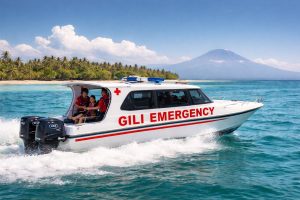
The boat ride itself is short. But emotionally? It stretches.
Salt spray on skin. Engine humming. Someone sitting very still, trying not to show pain.
This is where Gili Air ambulance to Lombok becomes more than logistics again. It becomes a shared silence between strangers.
Sometimes the water is flat like glass. Sometimes it’s not. Either way, the journey continues.
I remember thinking: this is probably what modern island healthcare looks like. Not perfect. Not polished. But alive.
And that matters.
Why This System Feels So Human
There’s no perfection here. No glossy brochure version of emergency care.
Just people doing what they can.
The Gili Air ambulance to Lombok system exists because it has to. Because isolation demands creativity. Because islands don’t negotiate with geography.
And maybe that’s why it works emotionally, even if it feels fragile technically.
There’s trust involved. A lot of it.
Trust in the boat. Trust in timing. Trust in strangers.
A Small Reflection Before Ending
I used to think emergency systems were all steel and precision. Now I think they’re more like relationships—messy, responsive, imperfect.
The Gili Air ambulance to Lombok route taught me that in a quiet way.
Not loudly. Not dramatically.
Just… steadily.
And when you leave the islands, you don’t really forget it. The sound of engines. The early morning light. The way people move when something matters.
It stays.
Somehow, it stays.
