
When people first arrive at Gili Islands, they usually think about slow island life, barefoot walking, and sea that looks like it’s been filtered. But emergencies don’t care about vibes. And somewhere between relaxing and reality, Gili Islands ambulance cost appears in conversations that feel a bit too real, too fast. Strange how a simple phrase suddenly becomes important.
It almost never crosses your mind on day one. Or even day three.
Then something happens.
And everything shifts.
Understanding Medical Response on the Islands
Medical care here feels small but structured in its own way. Not chaotic, just… limited in scale. The first thing travelers notice when they hear about Gili Islands ambulance cost is that it’s not just about transport—it’s about how survival logistics work on islands without cars.
There’s a rhythm to how emergencies are handled. Slow at first glance, but actually quite deliberate. A patient is assessed, stabilized, then decisions start forming.
And yes, costs enter the conversation earlier than most people expect.
It’s not dramatic. Just practical.
Sometimes uncomfortably practical.
The First Line: Local Clinics and Stabilization
The Gili medical clinic is usually where everything begins. Small rooms. Basic equipment. Calm staff who’ve seen this kind of moment before.
And in those rooms, Gili Islands ambulance cost is often quietly considered while doctors decide whether transfer is necessary. Not in a scary way—more like a checklist running in the background.
A cut, a fall, dehydration… many cases end here. But some don’t.
And when they don’t, movement begins.

How Emergency Transport Actually Works
Transport is not instant. It’s coordinated. A bit layered. A bit improvised, honestly.
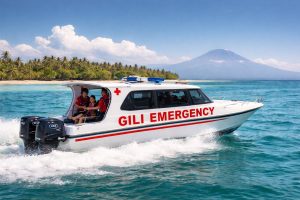
Patients are moved carefully from clinic to boat access points. Then across water to Lombok. That transition is where things feel the most real.
In many cases, Gili Islands ambulance cost depends on urgency, timing, and medical support required during transfer. Night evacuation? Different story. Stable daytime transfer? Different again.
It’s never one fixed number.
Never.
There’s always context.
Gili Medical Services in Action
The Gili medical service plays a behind-the-scenes role most tourists never see. Coordination, communication, timing.
And when things escalate, ambulance Gili teams step in quickly, linking island care with mainland hospitals.
At this stage, Gili Islands ambulance cost becomes part of the logistical decision—not as a barrier, but as a factor that shapes how the evacuation is arranged.
It’s surprisingly organized for something that feels so remote.
Still, a bit fragile too.
The Boat Ride That Feels Like a Corridor
There’s something unforgettable about emergency boat transfers. The sea is calm or rough, depending on luck. Lights bounce on water at night. Silence between instructions.
This is where reality sharpens.
And where Gili Islands ambulance cost is no longer abstract—it’s tied to fuel, crew, equipment, urgency.
People often imagine ambulances with sirens. Here, it’s different. The ocean is the road.
And that thought sticks.
What Actually Influences the Cost
There isn’t a single price. That’s the part people struggle with most.
Distance matters. Condition matters more. If oxygen support or medical supervision is needed, things change again.
So when someone asks about Gili Islands ambulance cost, the honest answer is always: it depends.
Maybe frustrating.
But true.
Sometimes weather even decides for you. And nothing moves until the sea agrees.
Real Situations That Make It Real
A traveler slipping off a scooter. A diver panicking after a deep dive. Someone collapsing from heat.
These things happen more often than people expect.
In those moments, Gili Islands ambulance cost becomes part of the conversation almost immediately after stabilization at the clinic or beach.
No panic. Just steps.
Assess. Stabilize. Transfer.
And repeat.
You can feel how practiced the system is, even when it looks simple from the outside.
Emotional Weight Behind Emergency Transfers
There’s always a quiet emotional layer here. Families waiting. Friends confused. Staff focused but human.
And somewhere in the middle of it all, Gili Islands ambulance cost sits like a background thought nobody wants to say out loud.
It’s not just money. It’s timing. Access. Distance. Uncertainty.
Funny how emergencies compress everything into decisions.
Fast ones.
Evacuation to Lombok Hospitals
Most serious cases end up heading to Lombok, where larger hospitals can handle advanced treatment. The boat ride is short, but emotionally it feels longer.
During this process, Gili Islands ambulance cost may increase depending on medical support onboard and coordination required with mainland ambulance teams waiting on arrival.
Nothing is random here. Everything is arranged quickly, almost like silent choreography.
You just don’t always see the planning behind it.
Coordination Between Island and Mainland Teams
Communication between ambulance Gili teams and mainland hospitals is constant during transfers. Phones, radios, timing updates.
And when delays happen—usually weather-related—everyone adjusts.
In those moments, Gili Islands ambulance cost is less of a focus than simply getting the patient safely across.
Because safety overrides everything else.
Why Travel Insurance Suddenly Feels Important
Nobody thinks about insurance while watching sunsets. But after hearing a few real stories, it starts to make sense.
Because when emergencies happen, Gili Islands ambulance cost can become part of a much larger medical bill that includes transport, treatment, and evacuation.
It’s not meant to scare anyone.
Just reality.
A quiet one.
Final Thoughts That Don’t Feel Final
Island life is beautiful in a way that almost feels unreal. But it’s also dependent on systems most visitors never notice.
Clinics. Boats. Coordination teams. People who respond fast without making it dramatic.
And through all of it, Gili Islands ambulance cost becomes more than a phrase—it becomes part of how care actually moves across water, between islands, between decisions.
Maybe it’s not perfect. Maybe it never feels fully predictable.
But it works.
And sometimes, that’s enough when you’re standing on a dock, watching a boat disappear into the dark, hoping everything goes right.
