
You probably didn’t fly all the way to Indonesia thinking about Gili T emergency boat transfer. You came for the reef. The barefoot dinners. The slow mornings with salty air sticking softly to your skin.
And yet… on an island without cars, without a large hospital, without the kind of facilities you’re used to back home, Gili T emergency boat transfer quietly becomes one of the most important systems you never see.
Not dramatic. Not advertised on billboards. Just there.
And when something shifts—from “I’m fine” to “I need help”—that system moves fast.
Understanding Gili T Emergency Boat Transfer in Real Life
Let’s ground this in reality.
Gili Trawangan is small. Beautiful, yes. But medically limited. Minor treatments can be handled by local clinics and Gili medical service providers. Cuts, mild infections, dehydration—manageable.
But when a condition escalates, the equation changes.
A suspected stroke. A diving-related injury. A severe allergic reaction that doesn’t calm down.
That’s when Gili T emergency boat transfer becomes the bridge between island care and advanced facilities in Lombok.
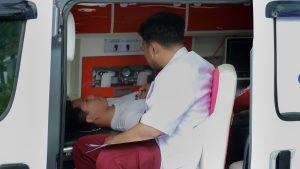
The process isn’t chaotic like in movies. It’s coordinated. Usually it begins with a call—often through your hotel, dive center, or directly to Gili emergency service contacts. Medical staff assess the patient first. Stabilize if possible. Oxygen. IV fluids. Monitoring.
Only then does the boat move.
Because rushing without preparation? That helps no one.
I once spoke with a hospitality manager on the island who described a late-night evacuation. The guest had intense abdominal pain. At first, everyone thought it was food poisoning. It wasn’t. Within an hour, the Gili T emergency boat transfer was arranged. Quietly. Efficiently. No shouting. Just clear steps.
That calm coordination stays with you.

Why an Emergency Service Network Is Essential on Gili T
Small islands operate differently from cities. That’s part of their charm—and their limitation.
There’s no ambulance weaving through traffic. No multi-story emergency department five minutes away. Instead, the island relies on a layered system:
-
Initial response from Gili medical service clinics
-
Assessment and stabilization
-
Activation of Gili emergency service coordination
-
Execution of Gili T emergency boat transfer
It sounds simple when written like that. In practice, it requires communication across teams, boat operators, medical staff, and receiving hospitals in Lombok.
And weather. Always the weather.
The sea can be gentle like glass in the morning, then restless by afternoon. During rainy season, wind patterns shift quickly. Still, the emergency service continues functioning. Routes adjust. Timing adapts.
Because the alternative—doing nothing—isn’t an option.
Situations That Lead to Gili T Emergency Boat Transfer
Not every medical issue requires evacuation. That’s important to understand.
But some scenarios tip the scale:
Diving incidents are one of the more serious triggers. Rapid ascents, decompression concerns, neurological symptoms—these demand swift evaluation beyond what the island alone can provide.
Then there are traumatic injuries. Bicycle accidents on sandy paths aren’t uncommon. Most are minor. Some are not.
Heat-related illness also appears more often than travelers expect. The tropical sun feels forgiving at first. Then it doesn’t.
And occasionally, it’s something internal and invisible. Severe infection. Sudden chest pain. A child with persistent high fever.
In these moments, Gili T emergency boat transfer stops being a phrase and becomes movement. Decisions. Engines starting.
You can almost feel the shift in atmosphere when it’s activated. Conversations become focused. Steps shorten. Eyes sharpen.
The Human Side of Gili Medical Service Teams
We talk about systems. But systems are people.
Gili medical service professionals are accustomed to the island’s rhythm. They understand both the beauty and the boundaries of local care. Their job isn’t just treatment—it’s judgment.
When is local observation enough?
When is evacuation non-negotiable?
That decision carries weight.
I remember hearing a diving instructor describe how a clinic doctor hesitated for just a few seconds before recommending a Gili T emergency boat transfer. Not out of doubt—but out of calculation. Risk versus timing.
Those few seconds mattered. And then the decision was made.
Clear. Firm.
Gili emergency service coordination followed immediately.
It’s reassuring to know that hesitation doesn’t mean confusion. Sometimes it means expertise thinking fast.
Night Transfers Feel Different
During the day, the sea looks manageable. Blue. Open. Predictable.
At night? Everything shifts.
The dock feels quieter. The air heavier. You hear waves more sharply when visibility drops. A Gili T emergency boat transfer at 11 PM carries a different emotional tone than one at noon.
Lighting has to be arranged. Communication with Lombok hospitals confirmed. Boat captains assess sea conditions carefully.
And yet the process continues.
There’s something strangely comforting about knowing that even when the island sleeps, the emergency service does not.
It changes your perception of remoteness. You’re on a small island, yes—but not cut off.
Preparation: The Quiet Advantage
Most travelers don’t prepare for emergencies. Understandably. You’re thinking about snorkeling, not evacuation logistics.
Still, small actions make a difference.
Save a Gili emergency service contact in your phone.
Check whether your travel insurance covers Gili T emergency boat transfer.
Inform companions about allergies or medical conditions.
These steps don’t take long. A few minutes. But they change your psychological landscape.
Preparedness reduces panic.
And panic, in emergencies, slows everything down.
I’ve seen travelers visibly relax after learning how Gili medical service and boat transfers operate. Knowledge removes uncertainty. Uncertainty is what fuels fear.
Costs and Realities You Shouldn’t Ignore
Let’s be direct.
A Gili T emergency boat transfer can be costly, particularly if it requires private speedboat hire at night or medical personnel accompanying the patient. Fees vary depending on timing and severity.
This is why insurance isn’t optional—it’s essential.
Some assume island stays are simple and therefore low-risk. But evacuation logistics naturally involve fuel, crew, coordination, and receiving hospital arrangements.
It’s not about being alarmist. It’s about being realistic.
And realism, oddly enough, creates peace of mind.

Speed, But Not Recklessness
One detail people rarely consider: speed must be balanced with stability.
Yes, emergencies demand urgency. But high-speed travel over rough water can worsen certain medical conditions. So Gili T emergency boat transfer teams evaluate not only “how fast” but “how safe.”
Stabilization before departure sometimes adds minutes.
Those minutes are strategic.
It’s easy to assume faster is always better. Medicine doesn’t always work that way.
Sometimes controlled movement beats raw speed.
A Safety Net You Hope to Never Use
Here’s the truth most returning visitors share: they never needed a Gili T emergency boat transfer.
But knowing it exists changed how they experienced the island.
They explored reefs more confidently, they cycled farther. They let their children play without that lingering “what if” thought dominating the background.
Because behind the postcard scenery, an emergency service framework stands ready. Gili emergency service teams coordinate. Gili medical service providers assess and act. Boats remain on call.
Quietly.
And that quiet presence matters.
Paradise doesn’t mean perfection. It means beauty within real-world conditions. Infrastructure doesn’t diminish the island’s charm—it supports it.
So when you arrive on Gili T and feel the sand warm under your feet, remember this: the same island that offers sunsets and coral gardens also maintains a structured Gili T emergency boat transfer system for when life takes an unexpected turn.
You may never see it in action.
But it’s there.
And sometimes, just knowing that is enough to let you breathe a little deeper.
