
If you’ve ever pictured yourself cycling along sandy paths with the ocean sparkling beside you, or waking up to calm turquoise water—yes, that’s the Gili Islands. But behind the dreamy scenes, there’s one important thing most travelers forget to plan for: Gili Islands ambulance services.
Strange topic for a tropical getaway? Maybe. But honestly—this is exactly the kind of information you’ll be glad to know before you ever need it.
A few years ago, I had a moment on Gili Trawangan that completely changed the way I view travel safety. A friend of mine suddenly collapsed after snorkeling. And just like that, the holiday vibe turned into a real-life test of how emergency care works on an island with no cars. Spoiler: it surprised me—in a good way.
So in this guide, I’ll walk you through everything you need to know about the Gili Islands ambulance, how to access help, what the system actually looks like, and why you should care even if you’re healthy and adventurous. Let’s dive in.
Understanding How the Gili Islands Ambulance Works (Because It’s Not What You Imagine)
Here’s something most people don’t realize before visiting the Gilis:
There are no motorized vehicles allowed—no cars, no trucks, no standard ambulances. So when someone calls an emergency service, the response looks a little different.
The Gili Islands ambulance takes the form of electric emergency carts or modified transport units designed to move quickly across narrow sandy paths. In some areas, responders even use adapted local transport to reach people fast.
Is it effective? Surprisingly—yes.
These responders know every corner of the islands, and they can navigate far more quickly than a typical van-style ambulance stuck in urban traffic. When my friend passed out, the ambulance Gili team arrived in under ten minutes, weaving through bicycles, tourists, and beach paths with impressive skill.
Once on site, their main job is to stabilize the patient and transport them to the nearest Gili medical clinic. If the case is more serious, they coordinate a sea transfer to Lombok for hospital-level care.
Why the Gili Islands Ambulance System Matters More Than You Think
Let’s be honest—you don’t go to the Gili Islands thinking about emergencies. You think about sunsets, diving, good food, and that perfect slow island vibe. But that calm environment hides a simple truth: the islands are remote.
And because the islands are remote, knowing how the Gili Islands ambulance service works becomes a quiet form of protection.
1. Medical issues happen more often than you expect
Between snorkeling, diving, biking on uneven paths, dehydration, and heat exposure, incidents occur almost daily.
Not dramatic ones—just the usual “holiday mistakes.” But even those need quick care.
2. Response time matters
Because there’s no advanced hospital on the islands, the priority is speed and stabilization. That’s where the Gili emergency service shines.
3. Clinics have varying levels of equipment
Some clinics can do X-rays. Some can’t.
Some have doctors on-site. Others call them in.
The ambulance team knows exactly which Gili medical clinic suits your condition.

How to Contact the Gili Islands Ambulance (Seriously, Save This Tip!)
Here’s where things get critical.
Each island—Gili Trawangan, Gili Air, and Gili Meno—has its own emergency contact numbers.
Hotels, dive centers, and local shops typically have the number posted somewhere, but don’t rely on that. When emergencies happen, your brain doesn’t always cooperate. Trust me—I froze completely when my friend fainted.
A kind local stepped in and called for us.
To avoid that moment, do this on your first day:
-
Save the island’s emergency number on your phone
-
Ask your hotel for the latest Gili emergency service contacts
-
Check the nearest Gili medical clinic to your accommodation
-
Keep your phone charged and your data active
It takes two minutes and could genuinely make a difference.
What a Real Gili Islands Ambulance Response Looks Like
Imagine this:
You’re standing on a beach, the sun bouncing off the water, your skin still warm from a morning swim. Someone near you needs help. You make the call. Instead of loud sirens, you hear a soft electric hum approaching—or maybe the rhythmic steps of a cidomo horse cart adapted for emergencies.
It’s fast. Quiet. Focused.
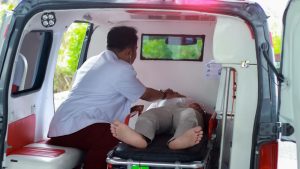
The responders arrive, assess the situation, and begin first aid immediately. Their calmness is reassuring, like they’ve seen this a thousand times. They stabilize the patient, lift them onto the cart, and take them straight to a Gili medical clinic.
If the condition requires hospital treatment, evacuation to Lombok is arranged swiftly, usually via speedboat.
It’s a system that works because it’s designed for the island’s realities—not despite them.
Urban Ambulance vs. Gili Islands Ambulance: A Quick Comparison
Most visitors imagine an ambulance full of medical equipment, with flashing lights and sirens. That’s not what you get on Gili.
But what you do get is an alternative system that’s surprisingly efficient given the location.
Urban ambulances offer:
-
On-board advanced equipment
-
Paramedics trained for a wide range of cases
-
Multiple hospitals within minutes
Gili Islands ambulance services offer:
-
No traffic
-
Rapid access to any spot on the island
-
Smooth coordination with Gili emergency service networks
-
Staff intimately familiar with the island layout
Different setups, but each one optimized for its environment.
The Role of Gili Medical Clinics in the Emergency System
Think of clinics on the Gilis as compact but functional emergency hubs.
Typical services include:
-
General doctors
-
Wound cleaning and stitching
-
First aid and trauma care
-
Oxygen support
-
IV drips
-
Some imaging equipment (varies by clinic)
You won’t find a full hospital here—that’s why the ambulance Gili team provides initial stabilization and coordinates evacuation when necessary.
When my friend was taken to a Gili medical clinic, he received oxygen and fluids almost immediately. An hour later, he was alert, hydrated, and joking again. We still talk about how unexpectedly smooth the whole process was.
Practical Safety Tips for Your Visit to the Gili Islands
The best emergency is the one you never have. Here’s what I always recommend to friends:
-
Drink more water than you think you need (the sun is intense!)
-
Wear reef-safe sunscreen to avoid burns
-
Bike slowly—those sandy paths are trickier than they look
-
Use proper fins when snorkeling
-
Don’t mix alcohol with ocean activities
-
Save your Gili emergency service contact
-
Know the nearest clinic within walking distance
Small habits make a huge difference.
The Gili Islands Ambulance Is There to Protect Your Peace, Not Ruin It
The Gili Islands ambulance system may look different, but it functions with surprising efficiency. It’s adapted to the islands’ no-car culture, and it ensures every visitor can get help quickly. Knowing this system exists—and understanding how it works—gives you confidence to fully enjoy the paradise around you.
Whether you’re visiting for snorkeling, sunsets, or just the sweet slow-living island atmosphere, having this knowledge in your back pocket makes your experience safer and more relaxed.
Travel safe, explore freely, and may your only “emergency” be deciding which beach bar to watch the sunset from.
